
REVIEW · ALPINE RAFTING & CANYONING ADVENTURES
Ötztal: Obere Auerklamm Canyoning Tour for Beginners
A canyon does not do slow mornings. The Ötztal Obere Auerklamm beginner tour mixes guided abseils, optional jumps, and real alpine thrills, all in a tight 4-hour block. I like that you are set up for success fast with certified instruction, and you finish with the 15-meter high-speed natural slide, one of the most memorable moments in the region.
You also get the practical comforts that make this kind of outdoor day easier to stomach, like clean, disinfected gear, a photo service, and warm showers at the end. One drawback to plan around: this tour is not suitable for non-swimmers, and there are limits for kids, pregnancy, and mobility needs.
In This Review
- Key highlights and what matters most
- Ötztal Canyoning for Beginners: why Obere Auerklamm fits first-timers
- Getting there and the 4-hour rhythm: how your day actually flows
- Safety first, and the real meaning of “certified guide”
- From the wooden bridge to your first abseil: learning without drama
- Devil’s Hole abseil and the stations where you choose your comfort level
- The slides and jumps you will remember, starting small then building up
- The 7-meter finale and how you leave the canyon feeling accomplished
- What to bring, and what you should leave at home
- Who should book (and who should not)
- Price and value: is $113 worth it?
- Language, group size, and why it helps on a first canyon
- Should you book the Obere Auerklamm beginner tour?
- FAQ
- Where is the meeting point for the tour?
- How long is the Ötztal Obere Auerklamm canyoning tour?
- What is included in the price?
- Is the tour suitable for children?
- Can I join if I am not a swimmer?
- What language will the guide speak?
- What do I need to bring?
- What if I want to abseil instead of jumping or sliding?
- What is the cancellation policy?
Key highlights and what matters most
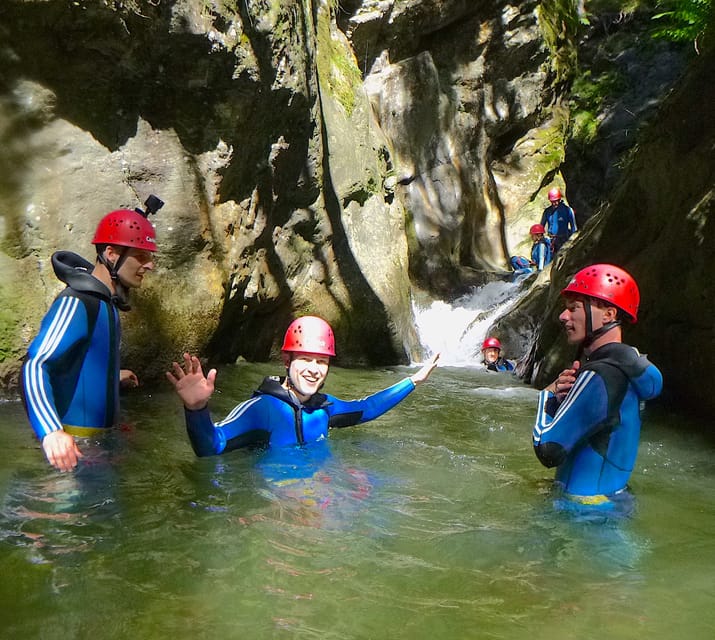
- Certified guides for beginners who teach you the moves step-by-step
- Optional jumps, slides, or abseils on multiple drops, so you can choose your comfort level
- Devil’s Hole abseil plus several waterfall stations that keep the action constant
- The 15-meter high-speed slide after a run of smaller challenges that build confidence
- Photo service and after-tour drink to help you actually enjoy the day, not just manage gear
- Warm showers and changing rooms to make the hike out feel like a proper finish
Ötztal Canyoning for Beginners: why Obere Auerklamm fits first-timers
If you have never tried canyoning, this is the kind of tour that helps you work up confidence without turning the day into a test. Obere Auerklamm in the Ötztal area is built around a sequence of controlled descents. You start with instruction, you get hands-on technique, and you keep moving through short, clearly defined challenges.
What makes this one feel beginner-friendly is the mix: fixed handrails, multiple places where you can choose how to descend, and guides who focus on safe positioning. You are not just dropped into the deep end. Even if you are nervous, you still get a plan, and the guide can adapt how you handle each station.
The second reason it works is the payoff. A lot of beginner canyoning tours include one highlight drop. Here, you get a run of fun stations that lead to the big moment: a 15-meter high-speed slide. That combo matters, because you stay engaged the whole time instead of waiting for the end.
More cold-water runs through alpine gorges:
- Imster Schlucht: White-Water Rafting in the Tyrolean Alps
★ 4.8 · 232 reviews - Salzburg: White Water Rafting on the Salzach River
★ 4.7 · 125 reviews - Salzburg: River Rafting Trip for Beginners
★ 4.8 · 102 reviews - Ötztal: Rafting at Imster Canyon for Beginners
★ 4.7 · 70 reviews
Getting there and the 4-hour rhythm: how your day actually flows
Plan for about 4 hours of total activity. You will meet at the Outdoorzentrum and arrive 15 minutes early. That buffer is not just for admin. It helps you get into the right gear, meet your guide group, and start the day without a rushed vibe.
From the outdoor center, you ride by minibus to the canyon entry point and later return the same way. Once you arrive, you begin with a safety briefing. This is where the guide covers how to move, how to manage the equipment, and what to do if you feel unsure.
Then the rhythm becomes a repeating pattern: short transfer on foot or through the canyon approach, a technique teaching moment, then a descent station. You keep getting small “wins” along the way, which is what you want on a first canyoning day.
The finale is not a long, complicated exit. After the last major drop, you head out via a secured cable route back toward the outdoor center. The day ends with the easy stuff: warm showers, changing rooms, and a post-tour celebration.
Safety first, and the real meaning of “certified guide”
In canyoning, safety is not a slogan. It is how the day is run. Here, your group gets a state-certified canyoning guide and high-quality gear, including harnesses and rope material. The tour also provides whitewater equipment that is washed and disinfected, which matters for comfort and hygiene when everyone is sharing the same gear system across different groups.
The guide leads every big technical section and demonstrates techniques before you go. The fixed handrail points at what you are meant to do: climb down in a controlled way first, get your footing, then transition into the next station with confidence.
One subtle thing I really like for beginners: the tour design gives you multiple options. For several drops, the tour explicitly supports descending by abseil, and for others you can choose to slide or jump. That means you do not have to match a single “audition” style. You can aim for what feels right, while still keeping the day exciting.
Also, small groups help. You are limited to 10 participants, which gives the guide room to keep an eye on everyone during transitions. That is the difference between feeling looked after and feeling like a number.
From the wooden bridge to your first abseil: learning without drama
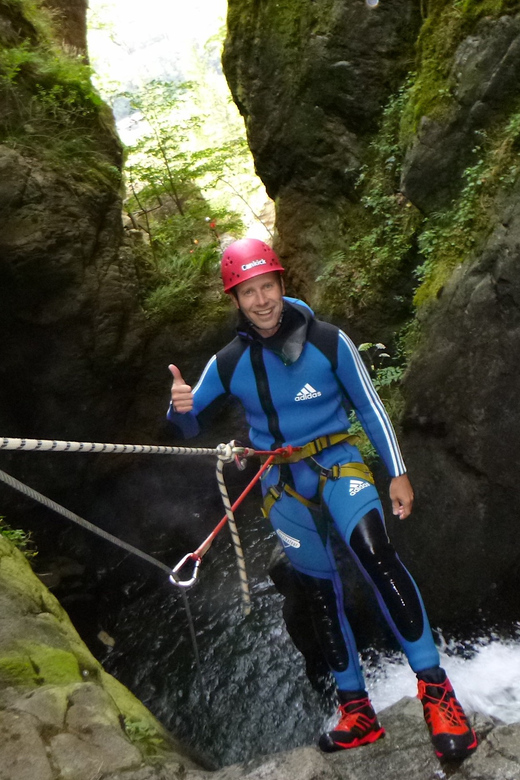
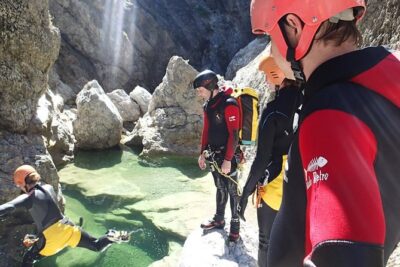
Your first major “getting into it” moment comes early. You pass a picturesque wooden bridge and reach the first descent where there is a fixed handrail. That matters because your brain can focus on balance and movement rather than figuring out where to put your feet.
Next comes your first significant technical challenge: a 5-meter abseiling point. The guide shows the technique, then you follow under supervision. This is where beginners usually need clarity on two things: how to control your speed and how to stay relaxed in a harness situation. When a guide takes that seriously, people usually go from stiff to steady quickly.
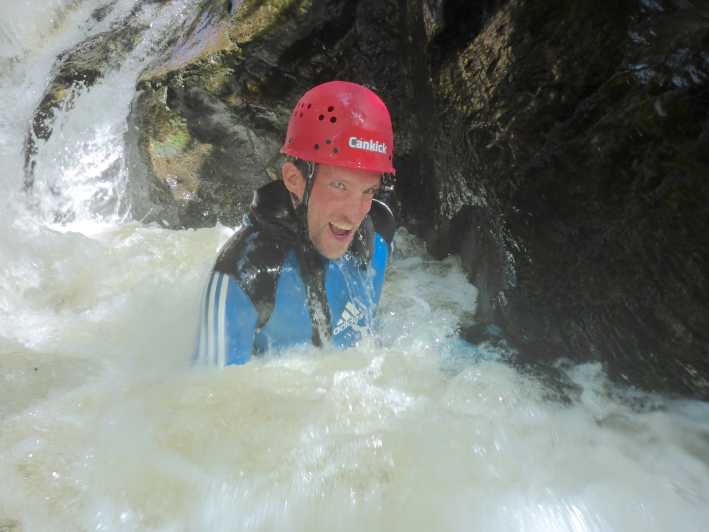
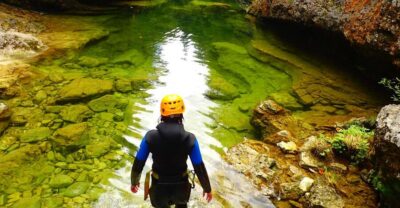
As you continue, the canyon narrows and the sound changes. Water and waterfalls get louder, and the route feels more “real” in an alpine way. That shift is part of why canyoning is so fun. It is not just activity, it is atmosphere, and you get it right away instead of after a long hike.
After the interval, more from the Alps:
Devil’s Hole abseil and the stations where you choose your comfort level
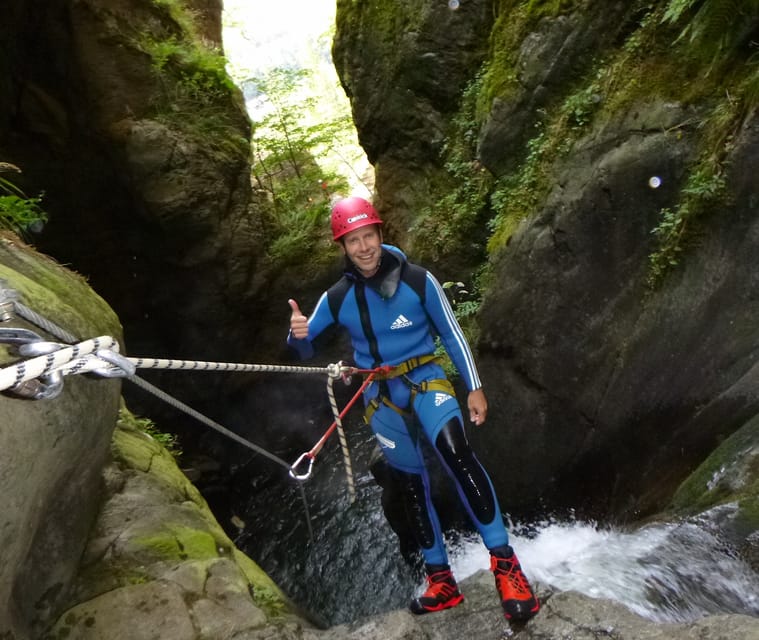
One of the most talked-about segments in this tour is the Devil’s Hole, where you abseil through with the guide. The name alone grabs attention, but the real value here is that you are not forced to guess your way through. The guide sets you up, and you progress station by station.
After Devil’s Hole, you hit another technical moment: a 9-meter abseiling section, followed by a short swim. That short swim is not just “fun water time.” It is part of how the route connects each action station while keeping the overall flow moving.
Here is the best beginner-friendly concept in the whole day: many challenges are structured so that every section can be abseiled depending on your preference. You can opt into jumps and slides if you want more adrenaline, or you can keep it more controlled. That choice helps people who are unsure at the start, especially if you are still learning how your body feels in the harness.
If you are anxious about certain drops, you will likely appreciate how the guide handles nerves. At least one group experience I have seen on this route praised the friendly approach with no pressure when someone felt fear.
The slides and jumps you will remember, starting small then building up
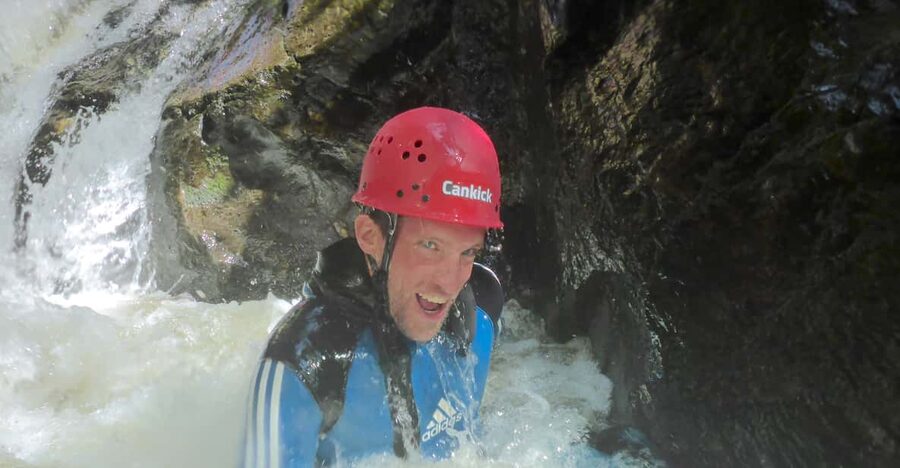
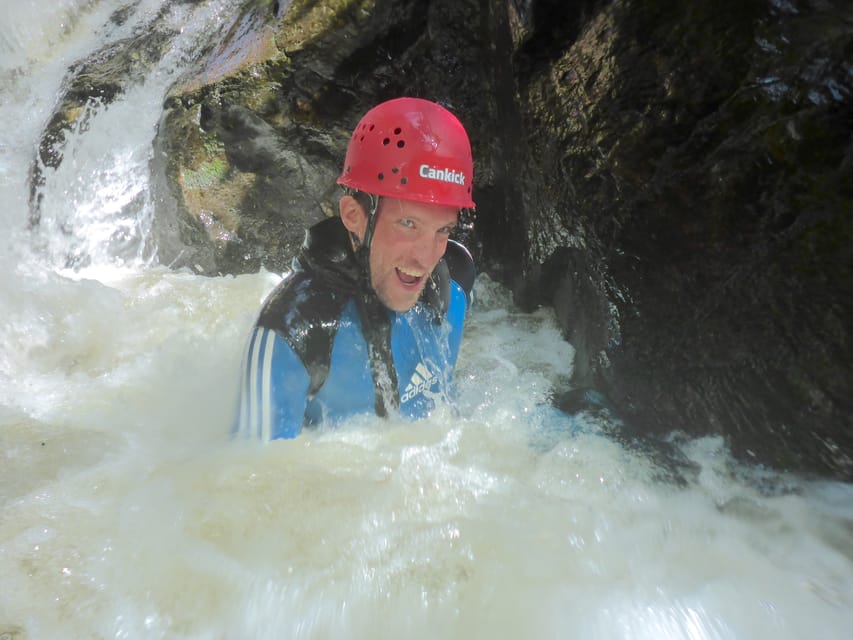
After the early technical stations, the tour leans hard into action. The canyon leads through a series of connected highlights that mix movement styles.
You pass a station sequence like:
- a 5-meter slide
- a 2-meter jump
- an 9-meter slide
- winding water basins that keep you moving
The reason this matters is psychological. You are not forced to jump straight to the biggest drop. You get smaller ones first, which helps you read the water, learn how to land, and get used to the idea of sliding or jumping from a canyon feature.
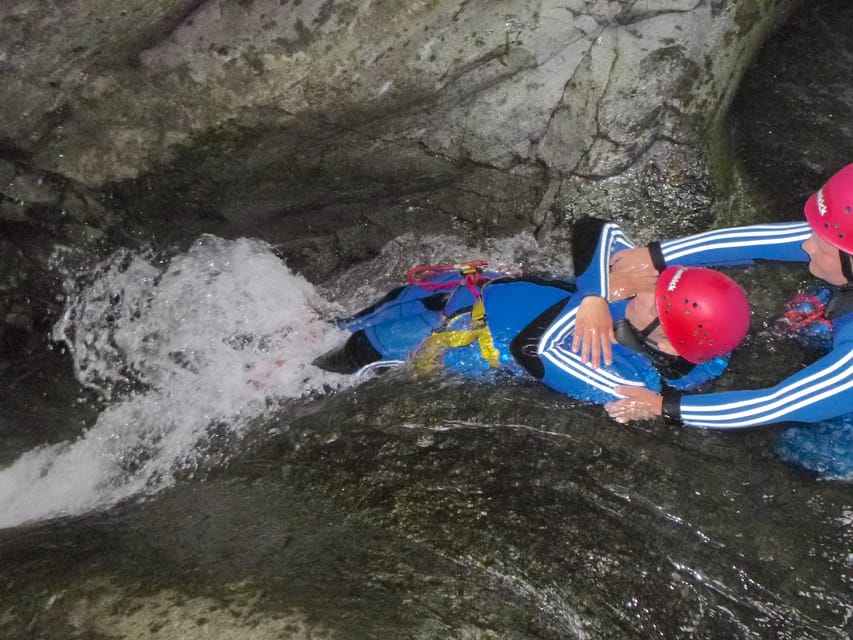
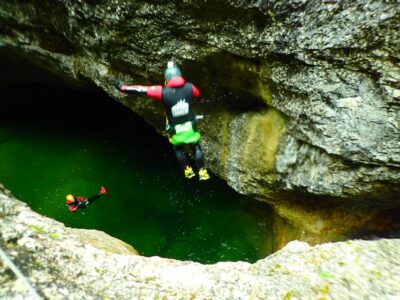
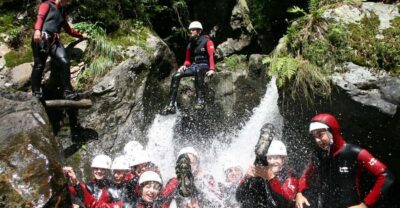
Then the big one arrives: a 15-meter high-speed natural rock slide. This is carved by water over millennia, so the slide shape feels like part of the canyon, not just a placed attraction. Even if you do not think you are brave, this is the kind of challenge where the guide’s setup and the clear path help most beginners pull it off.
Expect adrenaline here, but it is not just about speed. It is also about timing and body position, and that is exactly why you get instruction earlier in the day.
The 7-meter finale and how you leave the canyon feeling accomplished
After a short break, you continue into the final big challenge. A 7-meter-high descent closes the action. This is another station where you can choose your way down: abseiling, sliding, or jumping.
That choice is more than flexibility. It is how you tailor the day to your skill and comfort. If you learned to abseil earlier and feel good about it, you can repeat what worked. If you feel ready to be more playful, sliding or jumping lets you finish on a big high.
Once you complete the finale, you exit through a secured steel cable and head back toward the outdoor center. That secured cable exit feels like the “thank you for doing it” moment, because it is controlled and gets you out without adding another surprise technical section.
Back at the base, there is a post-tour celebration with canyon schnapps and a chance to unwind. You also get warm showers and spacious changing rooms. For many people, that is the best part of the whole day, because it turns a wet, physical adventure into a comfortable finish.
What to bring, and what you should leave at home
You only need a few things to show up properly:
- Swimwear
- Towel
The tour provides the canyoning gear, including harnesses and ropes, and the whitewater equipment is washed and disinfected. That reduces what you have to pack and keeps you from dealing with bulky gear on your trip.
Wear swimwear and plan for it to get wet and cold at times. You will also be spending time in flowing water, so you want quick-dry comfort once the tour ends.
On the personal side, this is a sporty activity. If you are expecting a gentle stroll, this will be more intense than that. The guide will manage risk and technique, but you still have to participate physically.
Who should book (and who should not)
This is a beginner canyoning tour, but it has clear boundaries.
Not suitable if:
- you are under 10 years old
- you are pregnant
- you have mobility impairments as noted for this activity
- you are a non-swimmer
There is also a teen rule: teenagers aged 12 to 15 must be accompanied by a parent. That is good to know in advance so you do not show up and learn the rule on-site.
If you do meet the requirements, this tour tends to be a strong fit for:
- first-time canyoners who want structured instruction and clear technique teaching
- people who want multiple action styles, not just one big jump
- anyone who likes the idea of choosing between abseiling, sliding, and jumping as you gain confidence
If you are unsure about your comfort level, you can still plan for the guided nature. The route includes sections where you can choose abseiling, and that flexibility is one of the best beginner supports.
Price and value: is $113 worth it?
At $113 per person for a 4-hour guided experience, this tour is priced like a real guided adventure, not a cheap thrill ride. The value comes from what you get included:
- round-trip minibus transfer from the base to the entry point and back
- a state-certified canyoning guide
- harnesses and rope material
- whitewater equipment that is washed and disinfected
- photo service from your tour
- a drink after the tour
- post-tour schnapps
- warm showers and changing rooms
That set of inclusions matters. You are not paying extra for the technical gear or leaving the day half-finished without comfort. The photo service is also a practical perk. If you are focused on your own technique, you can still leave with images that capture the action without stopping every few minutes to set a phone up.
Add in the group size limit of 10 participants, and the $113 starts to make sense as a cost spread across real guided time, safety equipment, and logistics.
Language, group size, and why it helps on a first canyon
You get a live guide speaking German and English. For first-timers, this matters because safety instructions are only useful if you understand them clearly.
The group is small, capped at 10. That means you spend more time with the guide and less time waiting for other people’s turns. It also makes the experience feel more personal when you are learning a technique for the first time.
You can also book with free cancellation up to 24 hours in advance and reserve now & pay later, which helps if weather or timing is a concern during your Tyrol trip.
Should you book the Obere Auerklamm beginner tour?
Book it if you want an active canyon day with real structure. I would choose this tour if you like the idea of learning abseiling early, then having the freedom to pick jumps and slides as your confidence grows. The Devil’s Hole abseil and the 15-meter high-speed slide are standout moments that make it feel like more than a basic intro.
Skip it if you do not swim or you do not meet the clear suitability rules. This is water, ropes, and controlled descents, not a casual walking tour.
One final decision tip: if you are worried about fear or technique, look for a guided group that stays calm and practical. On this route, that supportive style has worked for beginners across ages, including an experience where someone in their mid-60s felt well helped along the way.
FAQ
Where is the meeting point for the tour?
You meet at the Outdoorzentrum. Arrive about 15 minutes before the activity starts.
How long is the Ötztal Obere Auerklamm canyoning tour?
The duration is about 4 hours.
What is included in the price?
It includes cab transfer from the base to the entry point and back, a state-certified canyoning guide, harnesses and rope material, whitewater equipment that is washed and disinfected, photo service, a drink after the tour, warm showers, and changing rooms. There is also canyon schnapps after the tour.
Is the tour suitable for children?
It is not suitable for children under 10. Teenagers aged 12 to 15 must be accompanied by a parent.
Can I join if I am not a swimmer?
No. The tour is not suitable for non-swimmers.
What language will the guide speak?
The live guide speaks German and English.
What do I need to bring?
Bring swimwear and a towel.
What if I want to abseil instead of jumping or sliding?
Many sections can be done by abseiling depending on your preference, and the guide supervises the technical parts.
What is the cancellation policy?
You can cancel up to 24 hours in advance for a full refund.
Just added to the bill for the Alps
Alpine Rafting & Canyoning Adventures, compared.
Imster Schlucht: White-Water Rafting in the Tyrolean Alps
Read our review →
Ötztal: Canyoning at Alpenrosenklamm for Beginners
Read our review →
Canyoning for Kids and Families in Füssen, Germany
Read our review →Browse the lists this tour appears in