
REVIEW · SELF-GUIDED TOURS
Vienna: The Great Plague Exploration Game
Vienna turns into a puzzle game.
This Vienna plague exploration uses your smartphone as the guide, so you wander at your own rhythm while the city feeds you clues. I love the private setup, which keeps things relaxed for groups and families, and I especially like how it mixes big-name stops with quieter courtyards and odd details you would normally walk past. One consideration: if you want a classic lecture-style tour with lots of straight history facts, this is more of a question-and-search experience than a nonstop explanation.
You start at Ruprechtskirche, follow a clue chain through medieval Vienna, and end at the Hofburg. Along the way, you get audio stories, mini challenges at multiple stops, and chances to pause for a coffeehouse moment without dragging a group behind you.
In This Review
- Quick reasons to play this Vienna plague quest
- How this Vienna game turns walking into a real plan
- Before you start: what you actually need (and what you do not)
- Ruprechtskirche: start with 13 centuries of stone, bells, and stained glass
- Grecianbeisl: composer signatures and the Greek Inn story
- Bäckerstrasse courtyards: the wolf, the cow, and that strange backgammon mural
- Stephansplatz clue walk: turning a plaza into part of the story
- Stock im Eisen: nails, luck, and a small corner legend
- St. Stephen’s Cathedral: choose your view, then earn it with puzzles
- Café Frauenhuber: a coffeehouse pause that actually fits the story
- Albertina and the art of following clues to a big museum
- Hofburg Palace: ending the game in Vienna’s power center
- Price, timing, and value in 90 minutes at about $7.23
- Who should book this Vienna plague exploration game
- Should you book this Vienna Great Plague Exploration Game?
- FAQ
- Is this experience private for my group?
- Do I need to bring a guide or join a group tour?
- What language is the game available in?
- How long does the Vienna Great Plague Exploration Game take?
- Where does it start and where does it end?
- Are admission tickets included for the stops?
- Can I play at any time after booking?
- Is it suitable for children?
Quick reasons to play this Vienna plague quest
- No guide needed: you follow prompts and puzzles on your smartphone, with audio stories to keep you moving.
- Private for your party: it is set up so only your group participates, not a mixed crowd.
- Hidden-in-plain-sight sights: you are guided toward the specific corner details, murals, and old symbolism people usually miss.
- Made for families: it is built for kids who lose focus quickly, with an activity that pulls attention back in.
- Coffeehouse and classic Vienna landmarks: you get both the famous (Stephansdom) and the everyday (Vienna coffee culture).
- Admission varies by stop: some major sites are not included, so you can choose how much museum time you want.
How this Vienna game turns walking into a real plan
The biggest trick here is simple: instead of a fixed route with a person talking the whole time, you get a structure that makes walking purposeful. You still see the major postcard spots, but the game steers you toward smaller things you would not look for on your own.
The format also works well if you travel with kids, teens, or anyone who gets restless. You are not stuck in “stand and listen” mode, and you can slow down when something catches your eye.
You can also play it anytime after booking, and you do not need to reschedule. That flexibility matters in Vienna, where one rain shower can derail an overplanned itinerary.
More of Austria taken andante:
- Vienna: Tickets for Mozarthaus Vienna with Audio Guide
★ 4.2 · 2,344 reviews - Vienna: New Hofburg Palace Audio-Guided Tour & Entry Ticket
★ 4.1 · 566 reviews - Vienna: Schlumberger Wine Cellar Guided or Self-Guided Tour
★ 4.8 · 285 reviews - Vienna: Scavenger Hunt Self-Guided Tour
★ 4.7 · 83 reviews
Before you start: what you actually need (and what you do not)
You only need your smartphone. There is no physical guide meeting you for a lecture, so you will want to be ready to follow on-screen instructions and clue steps.
The route is built around short time blocks and repeated stops. For example, several locations are set up as quick “look around, solve, move on” moments, which keeps the whole outing from feeling like one long museum queue after another.
Also note that the experience is offered in English, and it is designed for most travelers to participate. Service animals are allowed, and the meeting point is near public transport, which helps if you are arriving by tram or metro.
Ruprechtskirche: start with 13 centuries of stone, bells, and stained glass
Your official start is St. Rupert’s Church, also called Ruprechtskirche, at Ruprechtspl. 1. This is not just a pretty church to tick off. It is one of those places that rewards close looking.
The standout details are what the game likely pushes you to notice. Ruprechtskirche is 13 centuries old, built with stone taken from an ancient Roman settlement. It is also home to some of the oldest elements in Vienna, including the oldest stained-glass window and the oldest bells.
There is one stained-glass scene in particular that dates back to the 13th century: Christ on the cross, with the Madonna and Child below. If you are a detail person, you will enjoy the extra time spent hunting for that image rather than drifting past it.
In summertime, the church hosts atmospheric concerts of ancient music, with evening performances in July. Even if you do not catch a concert, knowing that the space was designed for music changes how you experience it.
Practical note: this stop is marked as admission free, and your time here is short, around 10 minutes.
Grecianbeisl: composer signatures and the Greek Inn story
Next you head to Griechenbeisl, a famous tavern tied to some of Europe’s best-known composers. It is also the kind of place where history is not stuck behind a rope. You can look for the clues and then browse the room that holds framed signatures.
Mozart, Beethoven, and Schubert are all associated with dining here at one point. The tavern also has a Mark Twain room, where you can find additional celebrity signatures, including names like Luciano Pavarotti and Johnny Cash.
Then there is the name itself. Griechenbeisl means Greek Inn, and the story goes back to Greek tradesmen and Levant travelers who settled nearby. It helps to think of this stop as more than a claim on a plaque. It is a neighborhood restaurant with a long memory.
Expect another quick puzzle moment that asks you to look around. This keeps the experience from turning into passive sightseeing.
This stop is also listed as admission free, and you should plan around 15 minutes.
Held over another night in Vienna
Bäckerstrasse courtyards: the wolf, the cow, and that strange backgammon mural
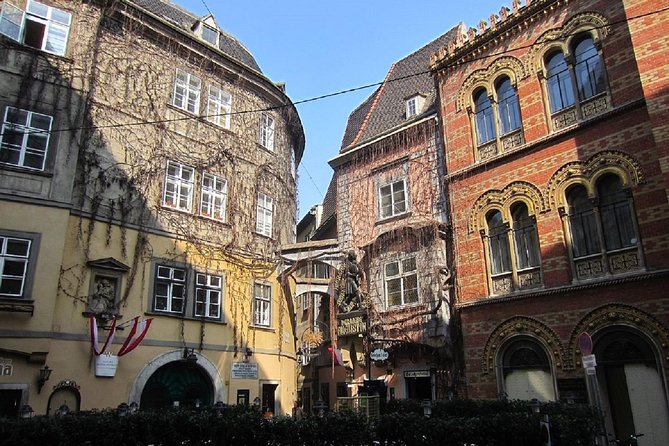
After that, you move into Bäckerstrasse, a street known for charming interior courtyards and older façades. The game nudges you toward Bäckerstrasse No. 2, on the façade of the Hasenaus, often nicknamed Hare House.
The mural you are searching for is the star. It shows a wolf and a cow wearing spectacles, playing backgammon. You will probably not find that kind of image on a standard “major landmarks only” itinerary, which is exactly why it works.
There are a couple competing interpretations. Some people think it is related to an older depiction of medieval life. Others read it as an allegory tied to the conflict between Protestants and Catholics.
Either way, the value here is your own noticing. A game clue makes you stop. Stopping makes you actually see.
This part is short, around 5 minutes, and the stop is marked as admission free. You can also linger later if you spot other interesting façades along Bäckerstrasse, like the 17th-century tower at No. 2, the Palace of Count Seilern (1722) at No. 8, and the Schwanenfeld Haus around No. 16, with its Renaissance courtyard and arcades.
Stephansplatz clue walk: turning a plaza into part of the story
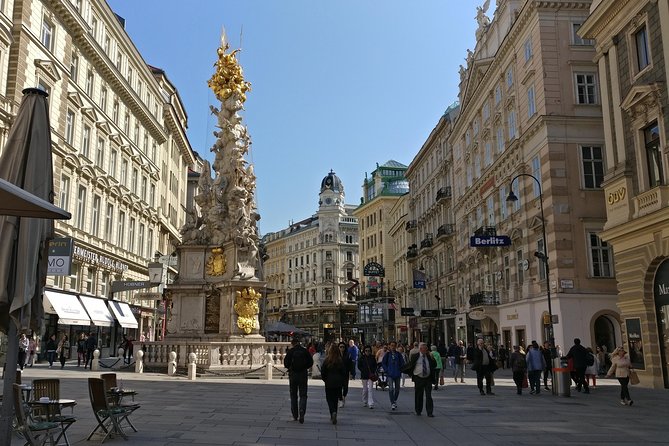
You then arrive at Stephansplatz. Here you get indications for how to continue the game, but you also get the feeling of being guided through the city like a living storybook.
This stage is set up around around 10 minutes. It is a transition stop, not a long sit-down museum moment, and that is a good thing. It keeps the pace moving and helps you avoid that Vienna problem where you mentally “arrive” at a place, take one photo, and then forget what you came to see.
Stock im Eisen: nails, luck, and a small corner legend
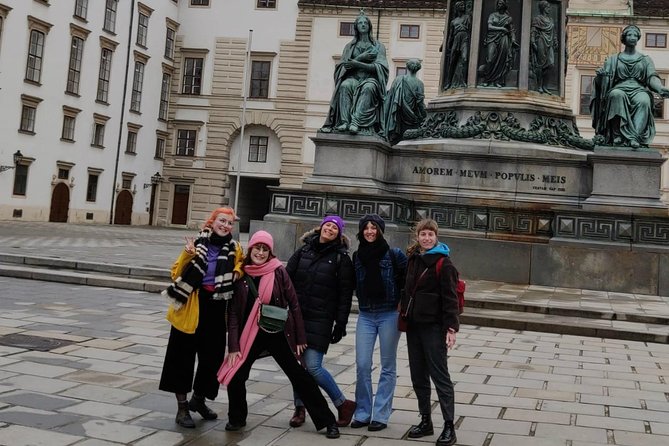
The next big visual you encounter is Stock im Eisen, the Nails Tree Vienna, on the corner of Karntner Strasse. The tree has a reputation that makes it sound almost supernatural, including a story that it was thought to be the work of Satan.
The reality is far more human. People hammered nails into the tree as a tradition believed to bring good luck. The tree’s trunk is surrounded by an iron ring with a lock dummy, and the mid-section sits on a pedestal about 1.5 meters high.
The hundreds of nails are the point, and the game gives you a reason to look closely instead of just walking by. You will also get another clue-based route step, so you feel guided on how to reach each next stop.
Plan for about 10 minutes here. There is no required museum time, and the entry is listed as admission free.
St. Stephen’s Cathedral: choose your view, then earn it with puzzles
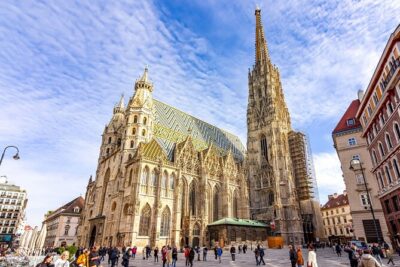
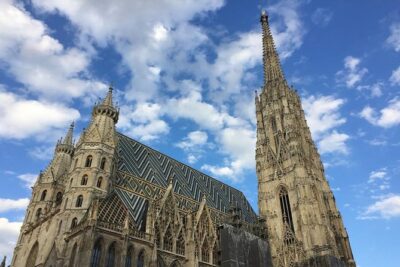
Now you are in Stephansdom, one of Vienna’s most important Gothic landmarks, with a history that goes back to the 12th century. The cathedral is famous for scale and details, but the game approach makes you look for specific story beats rather than just taking in the façade.
The tower room offers a breathtaking view of Vienna and includes 13 bells. If you can handle the stairs, that view is the kind of payoff that makes the rest of the day feel connected.
Then there is the roof, made of 230,000 glazed tiles in different patterns. The mosaics include a double-headed eagle symbol that relates to Austria’s imperial past under the Habsburgs. Other eagles on the north side carry coats of arms representing the city of Vienna and the Republic of Austria.
Here the game again asks you to look around to find answers to a question or challenge that unlocks your next move. That is a smart way to keep a major sight from feeling like a vague blur.
Important practical point: admission for this stop is not included. Your game still takes you there and uses it for the storyline, but you choose whether to pay for tower access and whatever internal areas you want.
There is also a built-in coffee break stop right after, at Café Frauenhuber, which is where this outing becomes very Vienna.
Café Frauenhuber: a coffeehouse pause that actually fits the story
The game includes a stop at Café Frauenhuber on Rauhensteingasse, famous as one of Vienna’s oldest coffeehouses, dating back to 1746. It is described as welcoming and unpretentious, which matters because classic Vienna coffeehouses can sometimes feel like you are paying for the room more than the drink.
The more interesting detail is the link to major composers. The place is known for having had Mozart and Beethoven play table music for dining guests between 1782 and 1791. That detail changes the feeling of what you are doing. You are not just fueling up, you are stepping into a tradition.
This is also framed as a peaceful coffeehouse atmosphere. Even if you arrive during busier hours, choosing a slow pause here is part of getting value from the whole game format.
The data here does not say admission fees apply, because it is a café break. What you spend, and how long you stay, is up to you.
Albertina and the art of following clues to a big museum
Your next major stop is the Albertina. This is one of Austria’s most popular museums, housed in the largest Habsburg residential palace, Hofburg Palace.
The Albertina is known for prints and drawings, with over 50,000 drawings and over 1 million master prints on rotational display. The game still uses puzzles to keep you engaged, but this is your chance to switch from “look for the answer” mode to “choose what you want to see.”
The museum also includes multiple collections tied to modern art, graphic art, architecture, and photography. If you want a highlight, Monet’s The Water Lily Pond is specifically mentioned as a notable work.
This stop is marked as admission ticket not included. Translation: treat it as an optional add-on that you can make as short or as long as you want, depending on how your day is going.
Your allocated time is around 10 minutes for the game mechanics, but you can linger if you want to browse extra galleries.
Hofburg Palace: ending the game in Vienna’s power center
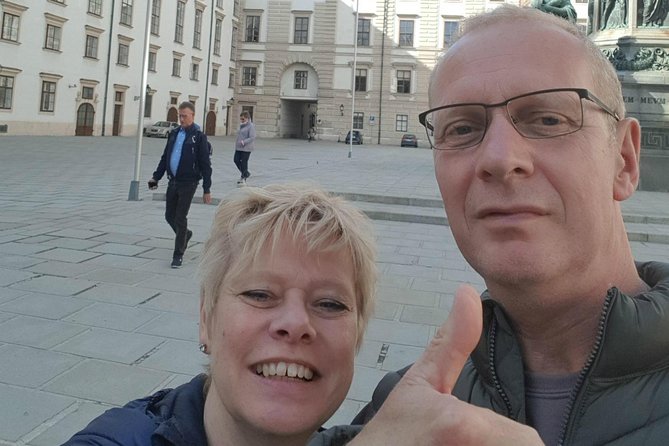
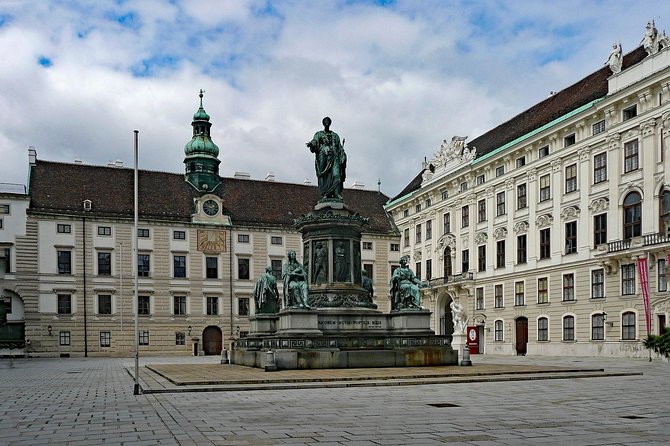
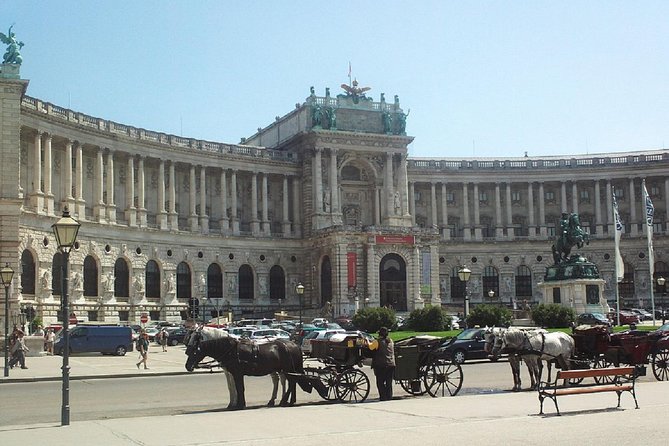
The Hofburg is where the city game ends and you can keep exploring on your own. The Hofburg is the current home and workplace of the President of Austria, and it has been a center of power in Vienna since the 13th century.
You will also see why the place still feels imperial. It served as the residence and seat of government of the Habsburg emperors until 1918. The palace reflects that past through richly decorated imperial apartments, including 24 rooms mentioned in the description, plus the Sisi Museum dedicated to Empress Elizabeth and lavish silver collections.
The National Library is also found in the Hofburg Palace. There is also a Hall of Ceremonies, built in the 19th century, still used for Viennese balls.
Like Albertina, this stop is listed as admission ticket not included. The game ends here, but you can decide how deep you want to go.
The game time at this stage is around 10 minutes. Practically, it is a good “end point” because you are already in an area with plenty to do after the quest finishes.
Price, timing, and value in 90 minutes at about $7.23
The price is listed as $7.23 per person, with the experience lasting about 1 hour 30 minutes. That might sound short, but it is designed that way on purpose. You do not spend your whole time queued up or trapped in one room. You spend most of your time outside, moving between clues.
For that price, you get:
- a structured route through multiple historic locations,
- audio stories built into the experience,
- and the independence of playing without a physical guide.
So the real question is not just cost. It is what kind of traveler you are. If you enjoy active walking and noticing details, the game can feel like a bargain. If you want long explanations at every stop, you might feel like you are spending money on scavenging when you would rather be listening.
Also remember that some major attractions on the route are not included in admission. St. Stephen’s Cathedral, Albertina, and parts of Hofburg are places where you might still choose to pay. The value stays good either way, because the game still guides you to the main exterior and clue points even if you skip paid entry.
One more timing note: it is commonly booked about 10 days in advance, so if you travel in a busy period, I would plan earlier rather than later.
Who should book this Vienna plague exploration game
Book it if you want a family-friendly Vienna activity that keeps everyone looking up and moving forward. It is also great for couples or friends who enjoy puzzles and do not mind reading clue hints while you walk.
It is a strong fit if you like the idea of combining major landmarks with smaller details, like the nails tradition at Stock im Eisen or the backgammon mural on Bäckerstrasse. And because it is private for your party, you avoid the “someone always slows the whole group down” problem.
I would consider skipping it if you crave constant human narration. Also, if your top priority is museum depth at a specific site, you might still enjoy the game, but you may want a separate full museum visit to balance it out.
Should you book this Vienna Great Plague Exploration Game?
I think it is a smart choice if you want to see Vienna in a way that feels hands-on. The smartphone-led format, the clue-driven stops, and the mix of celebrated landmarks and small oddities make the walking more interesting than it would be with a standard route.
My advice is to approach it with the right mindset. You are not trying to speed through. You are trying to look. When you do that, Vienna gets a lot more fun, even if you have seen parts of it before.
If you are traveling with kids, or you just want a break from guided-talking tours, this one is worth reserving.
FAQ
Is this experience private for my group?
Yes. It is listed as a private tour or activity, meaning only your group participates.
Do I need to bring a guide or join a group tour?
No. The experience is designed with no physical tour guide. You use your own smartphone to play.
What language is the game available in?
It is offered in English.
How long does the Vienna Great Plague Exploration Game take?
The duration is approximately 1 hour 30 minutes.
Where does it start and where does it end?
It starts at Ruprechtskirche, Ruprechtspl. 1, 1010 Wien, Austria. It ends at the Hofburg, 1010 Vienna.
Are admission tickets included for the stops?
Some are free, like Ruprechtskirche and Griechenbeisl (and several other clue locations). Admission ticket not included for stops like St. Stephen’s Cathedral, Albertina, and the Hofburg.
Can I play at any time after booking?
Yes. You can play anytime after booking without rescheduling, and you can take a break for coffee and continue later.
Is it suitable for children?
Yes. It is listed as free for kids, and it is described as ideal for families with easily distracted children.
Just added to the bill for Vienna

Self-Guided Tours, compared.
Tickets for Mozarthaus Vienna with Audio Guide
Read our review →
New Hofburg Palace Audio-Guided Tour & Entry Ticket
Read our review →
Schlumberger Wine Cellar Guided or Self-Guided Tour
Read our review →
Vienna Walking Tour with Audioguide on Your Smartphone
Read our review →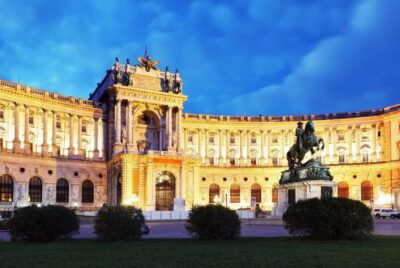
Browse the lists this tour appears in