
REVIEW · WALKING TOURS
Innsbruck Private Walking Tour
Innsbruck has a way of mixing power and drama fast. This private 90-minute walk gives you that exact combo, from Emperor Maximilian I and Maria Theresa to the city’s Olympic echoes at Bergisel. I especially love how the tour connects Gothic streets, baroque churches, and the Golden Roof without turning into a textbook. I also like the way the guide threads in legends and even older time periods, including Neolithic, Bronze Age, and Iron Age links. One thing to consider: entrance fees are not included, so if you want to go inside places, you may pay extra on the day.
You’ll stay in your own private group with a local guide who works only with you. Expect a careful pace through Innsbruck’s old town, with stops built around architecture, religion, and politics, plus music and cultural traditions along the way. It’s a smart choice when you want to cover the big landmarks but still understand what you are looking at.
The tour includes the guide, but not tickets. If your priority is maximum inside viewing, you may want to budget time and money for entry fees. Otherwise, you get a lot of meaning packed into a short stroll.
In This Review
- Key highlights to watch for
- Bergisel Ski Jump: Olympics, myths, and a city built in layers
- Golden Roof and the Gothic core: the postcard landmark with real explanations
- Imperial Palace and Albrecht Dürer: a date you can hang on
- Imperial Court Church and Maximilian I: the empty tomb twist
- St Jacob Cathedral and Lucas Cranach the Elder: baroque art with a famous name
- Maria-Theresien-Straße and the Triumphal Arch: the street where power walks
- Neolithic, Bronze Age, and Iron Age connections: the deep time thread you might not expect
- Music and cultural traditions: the human side of the architecture
- Price and value: $266 per group up to 15, and what that means for you
- Who this tour fits best in Innsbruck
- Should you book this Innsbruck private walking tour?
- FAQ
- Where is the Innsbruck private walking tour located?
- How long is the tour?
- What is the price?
- Is this tour private?
- What languages are available?
- Are entrance fees included?
- What sites will I see on the tour?
- Is there free cancellation?
- Can I reserve without paying right away?
- Do I need to choose a starting time?
Key highlights to watch for
- Bergisel Ski Jump stories, including the idea of jumpers flying over murky places
- Golden Roof as Innsbruck’s signature landmark in the Gothic city center
- Imperial Palace completed in 1500, famously portrayed in watercolour by Albrecht Dürer
- Imperial Court Church and the empty tomb of Maximilian I
- St Jacob Cathedral with baroque works by Lucas Cranach the Elder
- Maria-Theresien-Straße and the Triumphal Arch of Innsbruck
Bergisel Ski Jump: Olympics, myths, and a city built in layers
Most Innsbruck walks start with the old center. This one begins by pulling your attention to Bergisel, home to the artificial ski jump platform tied to the 1964 Winter Olympic Games. Even before you reach the classic photo spots, you get a sense of how Tyrol treats sport like part of the city’s identity, not just an event.
Here’s the hook that makes this stop memorable: you’re told the jumpers fly over murky places. Whether you take that as literal scenery or more of a story device, it sets the tone. Innsbruck is not one-note. It’s a city where dramatic images matter, and legends travel as easily as facts.
If you like context, this is a great warm-up. The guide uses Bergisel to show how the city modernized and performed on a world stage, then you immediately bounce back into older Innsbruck where politics and religion still sit in the architecture. In other words, you get time travel without needing a museum ticket.
Practical note: since it’s a walking tour, you’ll want comfortable shoes, especially if the route includes steps or uneven surfaces around viewpoints.
More Guided Walks in Innsbruck
- Innsbruck: Private Walking Tour with a Local
★ 4.0 · 62 reviews - Innsbruck: A Walking Food Tour with Full Meal by Do Eat Better
★ 4.5 · 41 reviews - Innsbruck: Food Walk – Private Tour with a Licensed Guide
★ 5.0 · 35 reviews - Private Walking Tour of Innsbruck: A Journey Through Time
★ 5.0 · 9 reviews
Golden Roof and the Gothic core: the postcard landmark with real explanations
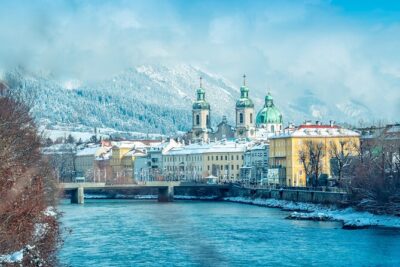
Next comes the Gothic city centre, where you’ll see why the Golden Roof is Innsbruck’s greatest tourist attraction and most characteristic landmark. It sounds simple, but a good guide makes it click. You are not just staring at a pretty facade. You’re learning why it matters in the way rulers presented themselves, how a city displayed status, and how architecture becomes political messaging.
The Golden Roof is the kind of place where people rush for a photo. I like that this tour builds it into a story thread, so you understand what you are seeing while you stand there. That turns a quick stop into something you can remember later, even when you’re back home sorting pictures.
This Gothic section is also useful for orientation. If it’s your first time in Innsbruck, you’ll leave with a mental map: where the old power lived, where the city showed off, and where the big religious buildings sit in relation to the streets.
If you’re the type who likes details, you’ll likely appreciate how the guide connects the aesthetics to the wider cultural traditions of Tyrol.
Imperial Palace and Albrecht Dürer: a date you can hang on
One of the most concrete stops is the Imperial Palace. You’ll be told it was completed in the year 1500, and that Albrecht Dürer portrayed it in watercolour. That’s a nice combination because it gives you both the timeline and the cultural proof that the palace was already famous beyond Innsbruck.
I like when a tour offers you something you can anchor to. A specific completion year does that. It also helps you interpret the surrounding streets. Suddenly, what felt like random buildings becomes a coherent picture of how authority was built into daily life.
The Dürer connection is also a good reminder that art travels. It’s not only that a palace existed, it’s that it was worth recording. When your guide points this out, you start to notice how visitors and artists helped spread the image of power.
Potential drawback: because entrance fees are not included, you might mostly view from outside, depending on what your guide can do during the 90 minutes. If you are hoping for a deep inside experience, keep that in mind and be ready for exterior viewing to be the main focus.
Imperial Court Church and Maximilian I: the empty tomb twist
Then you head to the Imperial Court Church. This is where the tour gets delightfully specific about religion and politics at the same time.
You’ll see it harbours the empty tomb of Emperor Maximilian I. The twist is important: Maximilian I is actually buried in Wiener Neustadt. That sounds like a small detail until you think about what it means. An empty tomb is not a mistake. It’s a statement. It signals presence, memory, legitimacy, and the way rulers wanted their stories carried forward in local spaces.
I love these moments where history refuses to be tidy. You walk in expecting one thing, then you learn there’s a deeper explanation built into the layout and tradition. It’s also a reminder that monuments and burials can serve different purposes, including political messaging.
If you enjoy religious architecture, this stop should land well. Even if you are not a history fanatic, the empty tomb concept gives the tour a human hook: someone is gone, but their symbols stay.
More of Austria on foot, bell tower to bell tower:


St Jacob Cathedral and Lucas Cranach the Elder: baroque art with a famous name
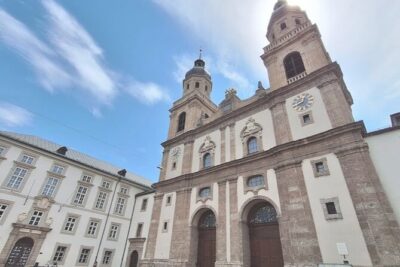
From there, you’ll look at St Jacob Cathedral, described as baroque and known for works by Lucas Cranach the Elder. This is another stop where the tour works because it ties art to place.
You are not handed a generic “baroque church” label. You get a specific artist. That makes it easier to spot what you are looking at and understand why people talk about this building.
I also like that this stop balances the imperial and political elements with a cultural one. Politics rules, yes, but so does visual art. In Tyrol, that mix shows up in church decorations and how institutions expressed faith and status through craftsmanship.
A useful expectation check: the tour highlight is the cathedral and its artworks, but entrance fees are not included. So you might spend your time observing what you can from accessible areas rather than taking in a fully guided interior circuit.
Maria-Theresien-Straße and the Triumphal Arch: the street where power walks
After the big landmarks, you’ll stroll through Maria-Theresien-Straße and see the famous Triumphal Arch of Innsbruck. This part of the tour works well if you like city planning and “how does a city move you” design.
Streets like this often function like open-air galleries. They connect institutions, route you through viewpoints, and create sight lines that make rulers feel close. The Triumphal Arch fits that idea perfectly. It’s a classic way cities mark achievement and send a visual signal that something mattered.
I appreciate that the tour doesn’t treat this as decoration only. The guide’s focus on religious and political history means you’ll connect why the arch exists to what the city needed to communicate at the time.
Also, this is a good stretch to reset your brain between heavier stops. After churches and palaces, an arch and a street give your eyes room to breathe while you keep learning.
Neolithic, Bronze Age, and Iron Age connections: the deep time thread you might not expect
Innsbruck is often treated as a medieval and imperial city. This tour adds another layer by mentioning connections to the Neolithic, Bronze Age, and Iron Age. That might sound abstract until you listen for how the guide links patterns of settlement and cultural change to the places you’re seeing now.
I like tours that don’t flatten everything into one era. If you enjoy historical continuity, this is your payoff. You learn that the ground beneath the city has held human activity long before the Gothic façades and imperial symbols.
How to make this useful for you: when the guide brings up older periods, try to think in terms of locations and continuity. Even without specific excavation details provided in the highlights, the point is clear: the city’s story did not start with one ruler or one palace.
Music and cultural traditions: the human side of the architecture
One of the tour’s promises is exploring music, architecture, and cultural traditions. You should expect the guide to use the buildings and historical figures as entry points into everyday cultural life, not just royal names.
That matters because Innsbruck is not only monuments. It’s a living city in Tyrol. When the guide connects traditions to the places you’re standing, you get a more believable picture of the past.
If you are the type who likes to understand the “why,” this is a strong fit. The tour is designed to explain what you see, including the interplay between religion and politics, and how those forces shaped local identity.
Price and value: $266 per group up to 15, and what that means for you
The price is $266 per group for up to 15 people, for a 90-minute private tour. That pricing structure is the key value lever.
If you travel as a couple or small group, the total cost will feel higher per person. But if you have a group of 8 to 15, the per-person cost drops fast because the price is for the group, not a set number of spots per traveler.
So the value question is really simple: how many people are in your group, and how much do you want the guide to focus only on you? Because it’s private and your guide stays with your group only, you can ask questions and keep the pace aligned with your interests.
Entrance fees are not included, so if you plan to go inside ticketed sites, budget a little extra. If your goal is mostly guided outside viewing plus context, the tour is often the kind of “pay for understanding” experience that works well.
And yes, it’s offered by Travmonde OÜ, so you are booking a tour operator rather than a museum-only program.
Who this tour fits best in Innsbruck
This tour is a smart match if you:
- Want a private guide and a focused, 90-minute format
- Like architecture that comes with a story, not just dates
- Care about how rulers shaped cities, especially through religion and politics
- Want quick Olympic context tied to Tyrol’s capital
It may not be the best choice if your main goal is deep museum time or heavy indoor ticketing, since entrances are not included and the highlights focus on key sights you can process efficiently on foot.
Language-wise, you get live guidance in English or German, which is great if you want clarity and direct answers instead of reading everything on your own.
Should you book this Innsbruck private walking tour?
If you want a compact way to understand Innsbruck, I’d book it. The strengths are clear: the Golden Roof and Gothic center, the Imperial Palace with the Dürer connection, the Imperial Court Church with Maximilian I’s empty tomb, and baroque art at St Jacob Cathedral through Lucas Cranach the Elder. Add Bergisel and the 1964 Winter Olympics angle, and you get a tour that spans eras without feeling scattered.
Book it if your group can fill enough seats to make the per-person math comfortable, and if you’re happy to treat it as a guided walk with context, not a ticket-heavy museum day. Skip it only if you know you want lots of paid interior access and are planning to spend most of your time inside.
FAQ
Where is the Innsbruck private walking tour located?
It takes place in Tyrol, Austria, in Innsbruck, the region’s capital.
How long is the tour?
The tour duration is 90 minutes.
What is the price?
The price is $266 per group, up to 15 people.
Is this tour private?
Yes. It is a private group tour, with a local guide who will be with your group only.
What languages are available?
The live tour guide is available in English and German.
Are entrance fees included?
No. Entrance fees are not included.
What sites will I see on the tour?
You will visit major sights such as the Golden Roof, the Imperial Palace, the Imperial Court Church, St Jacob Cathedral, Maria-Theresien-Straße, the Triumphal Arch of Innsbruck, and you will also explore Bergisel and its ski jump platform.
Is there free cancellation?
Yes. You can cancel up to 24 hours in advance for a full refund.
Can I reserve without paying right away?
Yes. There is a reserve now & pay later option, so you pay nothing today.
Do I need to choose a starting time?
You can check availability to see starting times for the 90-minute tour.
Just added to the bill for Innsbruck

Walking Tours, compared.
Guided Walking Tour of City Center Highlights
Read our review →
Guided Walking Tour of City Highlights & Hidden Gems
Read our review →
Vienna Historic Center Small Group Walking Tour
Read our review →
Ghosts and Legends Guided Nighttime Walking Tour
Read our review →Browse the lists this tour appears in